Planting a Legacy: Students Help Grow Belton’s Future, One Tree at a Time
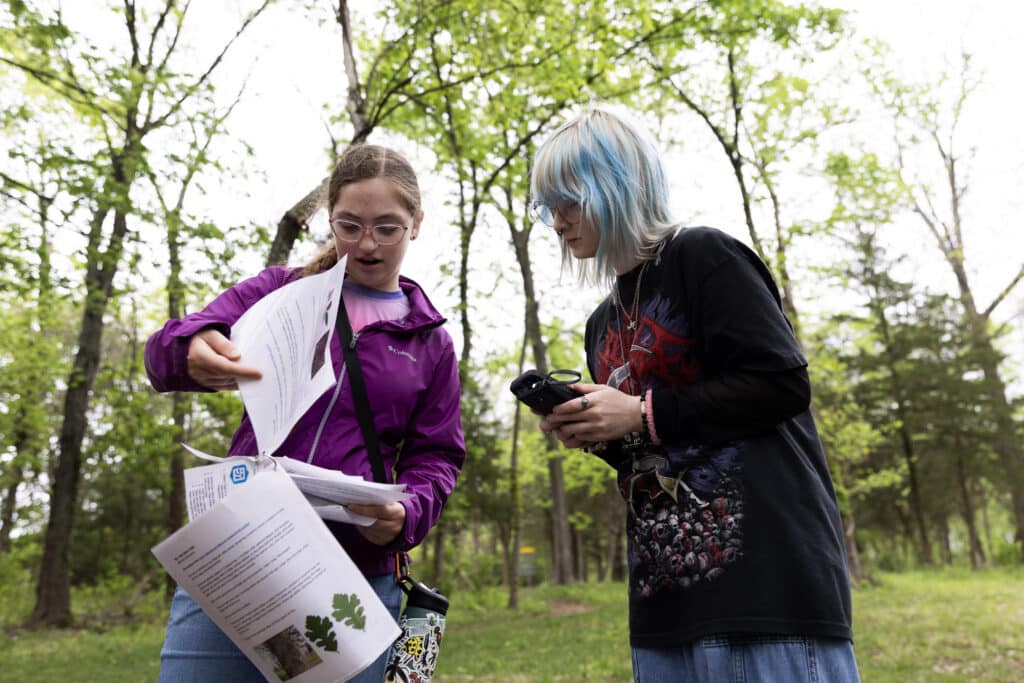
The rain had just passed, leaving a soft mist hanging over the trees at Dryden Nature Reserve. The ground was damp, the air quiet, and somewhere between the sound of dripping leaves and distant birds, a group of students moved carefully through the woods — pausing, studying, measuring, debating.
For Belton High School junior Lillian Floyd, it didn’t feel like school.
“It was a real misty day,” she recalled. “It had rained on us a little bit on the walk there. It was so nice out, and there are just plants everywhere . . . you get to see all the birds and the insects and everything that’s out there, and it’s so fun.”
Fun, sure. But also essential.
Floyd is one of dozens of students from Belton High School’s Science & Industry Academy helping the City of Belton tackle a deceptively complex task: geo-locating and tagging every tree across the Dryden Nature Reserve, which sits not far from the Belton High School campus. It’s meticulous, hands-on work, part science, part service, that forms the foundation for something much bigger.
If successful, their effort will help the city reach a critical milestone: designation as a Level III arboretum.
The story begins with a gift—and a promise.
“When Jack Dryden donated the land to the city,” said Belton City Parks Director Kevin Feeback, “he envisioned creating a space that not only celebrates nature and agriculture but also serves as an educational resource for future generations.”
That vision is now taking shape across the rolling acres near Cleveland Lake. But transforming land into an arboretum isn’t as simple as planting trees or building trails. It requires documentation, research, and proof. Specifically, proof of biodiversity.
Level III accreditation, which the project aims for, is granted by ArbNet. It requires at least 500 species and a demonstrated commitment to research, conservation, and education.
“It is important that we fight to preserve the urban tree canopy as the city continues to grow,” Feeback said.
Before the city can add anything new, it must first understand what’s already there. That’s where the students come in.
Step One: A Tree Audit
For the past two and a half years, students have been conducting what’s known as a tree audit; cataloging every tree across the reserve.
“It’s always better for the students to get out there and spend a week cataloging trees than it is sitting in a classroom and memorizing trees,” said Chase Nugen. Nugen, who serves as the district’s Academies Project Coordinator, is the connector behind the project. He’s the one who sees opportunity where others might see obstacles.
After reading about the land donation, he reached out to city officials with a simple idea: What if students could help?
“We sat down, and kind of looked at the plat map and realized there were a lot of things students could do,” he said. “Phase one… was the tree audit.”
The work itself is methodical and surprisingly collaborative.
Each team of students operates like a small field unit. One carries supplies — the “bagman”— holding nails, tags, and tools. Another identifies the tree using field guides, studying bark or leaves depending on the season. A third hammers a brass tag into the trunk. A fourth logs the data into a mapping app, dropping a precise GPS pin and recording the species.
“Every single tree,” Nugen said, “they’re working together and communicating back and forth constantly. ‘What do you got?’ ‘It’s a black locust.’ ‘How big is it?’ ‘Where are we going next?’”
It’s science in motion, and it demands something more than textbook knowledge.
Out in the reserve, the rules of school shift.
“You’re used to seeing all your friends inside of a classroom just sitting behind desks,” Floyd said. “But when they’re out there actually in the mud and brambles, it’s just a different experience.”
That difference matters. For many students, the project is their first exposure to real fieldwork. It’s one thing to learn about ecosystems in a lab. It’s another to stand inside one, to feel the terrain underfoot, to notice patterns in the trees, to recognize that forests aren’t random at all.
“I always thought forests were really mixed up,” Floyd said. “But it tends to be the same sort of trees in clusters. It’s interesting.”
The work also reveals something less tangible but just as important: connection.
“I feel like while you’re out there, you just feel really comfortable,” she said. “It’s quiet and peaceful . . . and it’s nice to hang out with your friends out in nature and help your community while doing it.”
That sense of purpose is exactly what Nugen hopes to create.
“When you give a young person autonomy and ownership over their learning experience,” he said, “it’s amazing what you see in their motivation, in their attitude, in what they want to do with their lives.”
There Are Projects, and There Are PROJECTS
For Feeback, the impact of the students’ work extends far beyond the data they collect.
“Geo-location creates an inventory of existing trees,” he explained. “It helps with planning, determines the health of the urban tree canopy, and ensures certain trees are protected during construction.”
But there’s something else happening, too. Something harder to measure.
“My ‘aha moment’ came when I observed students carefully working to identify tree species, concerned about making mistakes,” he said. “Their level of engagement demonstrated a genuine investment in the success of the project.”
It’s a level of ownership that might not exist in a traditional contract.
“A contracted firm likely would have approached the task as a routine assignment,” Feeback said. “But the students, they’re invested.”
That investment is shaping not just the project, but the students themselves. Nugen sees it in the progression from fall to spring — the quiet confidence that replaces uncertainty.
“Those same students come back, and they’re some of the first to raise their hands,” he said. “There’s a confidence about them that was not there at all in the fall.”
The Dryden Nature Reserve has become something rare in education: a classroom without walls. It’s also a reflection of how learning is changing.
“There are so many people who haven’t experienced high school the way we do it now,” Nugen said. “The school experience has a lot more flexibility to allow for that real-world learning.”
That flexibility is by design. As project coordinator, Nugen works to integrate community needs directly into student learning, treating partners like extensions of the classroom.
“I’m constantly reinforcing with them, ‘What is it that students could do?’” he said. “What could the school do to take the burden off?”
In Belton, the answer has led students into forests, onto construction sites, and into businesses across the community.
But the arboretum project stands apart.
“These are things that will continue for generations,” Nugen said. “They don’t go away.”
For Floyd, the experience has already begun to shape her future.
“It really showed me that I do like fieldwork,” she said. “It’s kind of a whole different ball game than lab work. It’s fun.”
She’s still deciding on a career path, drawn to both plants and animals and to the complexity of nature itself. But one thing is clear: her work here will stay with her.
“It’s kind of overwhelming to think about contributing something permanent,” Floyd said.
It’s the permanence that makes the project so powerful. Years from now, long after the last tag is placed and the last tree is mapped, the arboretum will still be there — growing, evolving, and serving the community. Students who once walked those trails will return as adults. They’ll drive past Cleveland Lake, maybe with children in the back seat, and recognize something familiar.
“Being able to drive by and say, ‘Hey, I did that. I helped build that,’” Nugen said. “There’s a legacy component to this. It’s a big deal in this town.”
For the City of Belton, the arboretum represents more than a designation. It’s an investment in health, environment, and quality of life.
“Studies indicate that access to trees and green spaces is associated with improved mental and physical health outcomes,” Feeback said, “as well as enhanced air and water quality.”
But for the students, the benefits are more immediate — and more personal. They’ve traded desks for dirt paths, lectures for lived experience. They’ve learned to work as a team, communicate and problem-solve in real time. And in the process, they’ve become part of something larger than themselves.
“The impact of this project,” Feeback said, “will be felt by students as well as residents for many generations.”
The Never-Ending Project
There’s one question Feeback hopes people will ask years from now: Will this project ever truly be completed?
It’s not a concern. Actually, it’s the point.
“This project is intentionally ongoing,” Feeback said, “designed to continuously provide meaningful, real-world learning opportunities for students.”
In that sense, the arboretum is not just a destination. It’s a living, evolving classroom; a place where each new group of students can step into the woods, pick up where the last left off, and continue the work.
Back on that misty morning, Floyd and her classmates moved from tree to tree, marking, measuring, mapping. Each tag, each data point, each quiet moment of discovery added another layer to the project, and another root to its legacy.
“It’s really a project that will allow the Belton community to have access to nature locally,” Floyd said, “and get to learn about and experience the outside.”
Then she paused, considering the weight of it all.
“I’m proud of the work we’re doing,” she said.
In the quiet of the forest, surrounded by trees that will outlive them all, that pride feels exactly where it belongs.