Transforming Learning Through Living
On any given school day, the house is alive.
There’s the clatter of dishes in the sink, the low hum of a washing machine, a group debating how much seasoning is too much, and laughter drifting in from the living room. Someone is learning how to fold a shirt. Someone else is figuring out when to ask for help — and when not to.
This isn’t a simulation. It’s not a lab. It’s not a classroom dressed up to look like something else.
It’s a house.
And inside the Raymore-Peculiar (Ray-Pec) School District’s Integrated Learning House (ILH), students of all abilities and interests aren’t just learning skills — they’re learning how to live.
According to Superintendent Dr. Mike Slagle, the idea for the ILH began with a conversation at a Starbucks on a Friday afternoon.
“It was a conversation between the parent of a special needs student and me,” Dr. Slagle said. “He wasn’t very enamoured of our program, and I wanted to listen to him to find out why.”
Dr. Slagle got an earful. Parents of students receiving special education services wanted more for their children, particularly those focused on functional life skills. A traditional classroom, no matter how well designed, couldn’t fully replicate the realities of daily life.
As Ray-Pec Chief Academic Officer Dr. Kristel Barr puts it, “That’s not an authentic experience. At home, you don’t have a janitor take out your trash, you do.”
Dr. Slagle decided that the district needed to do something bold. “I met with my cabinet the next Monday, and I said, ‘Folks, we’re going to build a house,” he said.
So they did. Not a model. Not a wing of a building. A real home, designed to feel and function like the places students would one day live on their own. From the beginning, the goal was clear: give students as much real-world learning as possible.
Designed With Students, Not Just For Them
What makes the ILH unique isn’t just what happens inside — it’s how it came to be.
Ray-Pec construction students helped design it. General education students offered feedback on layout and functionality. Trade students graded the land, wired the structure, and worked on plumbing and carpentry under professional supervision.
English students contributed by writing grants. Across disciplines, students weren’t just participants, they were creators.
“We went from spitballing at a Starbucks to collecting more than $114,000 and building a house in 14 months,” Dr. Slagle said. “That doesn’t happen without support from the board of education, the community and a dedicated team.”
Drs. Slagle and Barr immediately saw an opportunity to involve students from all walks to participate in the program.
“We value student voice in what we’re creating for them,” Dr. Barr said.
That philosophy shows up everywhere. The house continues to evolve, with improvements to accommodate vertical wheelchairs and other accessibility needs. Plans are underway for raised garden beds where students will grow vegetables and learn to prepare meals from the ground up. Landscaping lessons and, in true Missouri fashion, snow removal, are part of the vision, too.
The ILH isn’t a finished product. It’s a living environment that grows alongside the students it serves.
Step inside, and the difference is immediate.
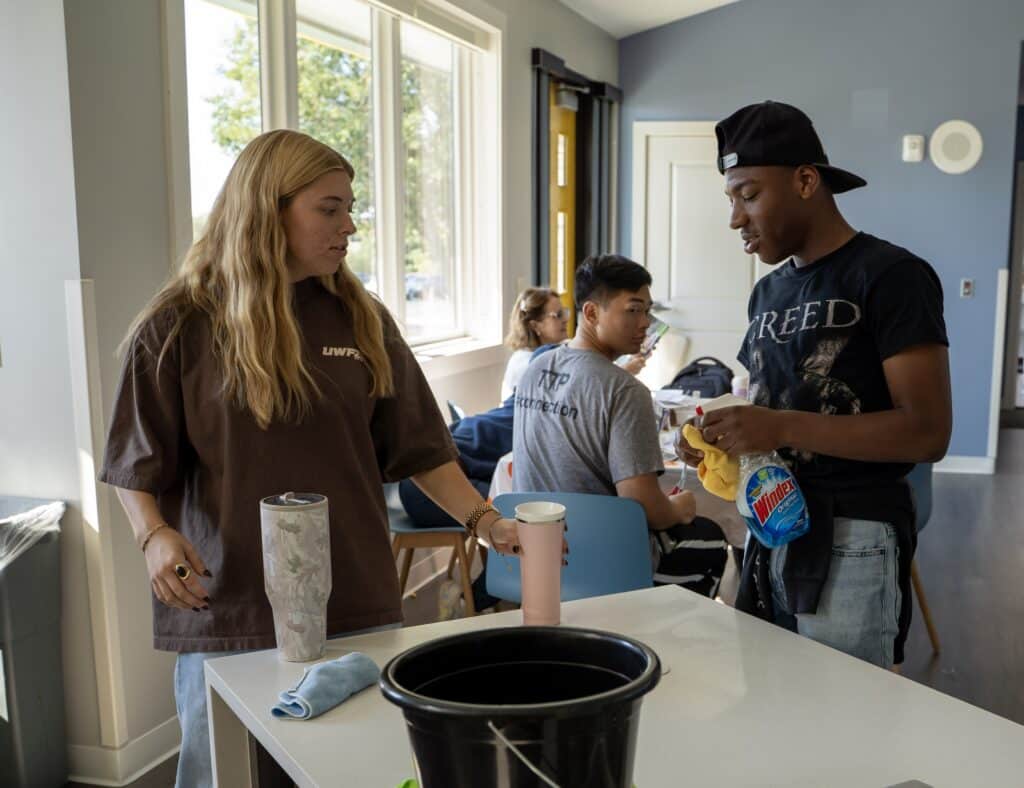
Three days a week, students rotate through the house in small groups, working alongside peers. The learning is hands-on, practical, and constant. Cooking meals. Washing dishes. Organizing a pantry. Making beds. Doing laundry. Practicing hygiene. Cleaning, folding, ironing. Even learning how to diaper a child or decorate for the holidays.
But what makes it powerful isn’t just the tasks — it’s the context.
“In a classroom, students might learn how to follow a recipe,” says special education teacher Katie Huff. “But transferring that skill to real life can be challenging. Here, they’re applying it in a natural environment where the expectations are real.”
And then there are the moments you can’t plan. A conversation while setting the table. A shared joke during yard work. A student realizes, mid-task, that they can do something they once thought was out of reach. Those are the lessons that stick.
“Anybody can build a house. What sets us apart is the amount of integration among students and community support,” Dr. Slagle said. “The house was built to help teach students, but it’s become so much more than that.”
Walking Alongside, Empowering All
At the heart of the ILH is a simple but powerful shift in mindset.
“It’s not doing things for students,” Barr explains. “It’s walking alongside them, guiding them, and teaching them.”
Peer mentors play a critical role in that work. General education students join their peers in the house, modeling skills, offering support, and building relationships. The demand is so high that there are more students who want to participate than there are available spots.
And the impact goes both ways.
SPED students in the house gain confidence and independence. They learn how to navigate daily life, how to collaborate, and how to advocate for themselves. Their peer mentors gain something just as valuable: perspective.
“They develop empathy, leadership, and communication skills,” Huff says. “They’re learning just as much.”
For many students, the ILH represents something new: connection.
“I see our functional life skills students becoming more social,” Barr says. “They’re out and about rather than being hidden in one room all day.”
The house creates opportunities for interaction that don’t always happen in traditional settings. Students who might not otherwise cross paths are working side by side. And those relationships don’t stay inside the house.
Teachers see students attend more school events, walk with peers in the hallways, and engage in everyday social moments — high fives, greetings, conversations — that signal something deeper: a growing sense of belonging.
“It exposes students to peers they wouldn’t normally interact with,” Huff says. “And they’re learning how to live and work alongside each other.”
From House to Community
The impact of the ILH extends beyond its walls.
Students have packed food bags for community members, sitting together afterward to talk and connect. Middle school programs are beginning to mirror the model, including a student-run coffee shop. Plans are in motion to expand opportunities at the elementary level.
There’s even a vision for what comes next.
A nearby building may become a pantry or general store, where students can apply their skills in a work-based setting. The progression is intentional: from learning in the house to contributing to the community.
“It’s more than just a house,” Barr says. “It’s the next step. They’re going to work.”
One of the most powerful examples of that growth came not in the kitchen or the laundry room, but on a stage.
Through a peer mentoring class co-taught by theater and special education staff, students collaborated on a production called Mother Goosed, a playful twist on classic nursery rhymes. General education students took on roles as news anchors. Students receiving special education services brought beloved characters to life. At first, some were hesitant, even afraid, to step on stage.
“By the end,” Barr says, “you couldn’t get them off.”
Parents watched, many in tears, as students who once shied away from the spotlight performed with confidence and joy. It wasn’t just a play. It was proof of what’s possible.
A Community Effort
The ILH is, in many ways, a reflection of the Ray-Pec community that built it.
Local businesses donated time, money, and materials, including a $50,000 donation from the J.E. Dunn construction company’s charitable foundation. Teachers across disciplines collaborated to create meaningful experiences. Staff members like Jonathan Benson and Kevin Kim work daily alongside students to bring the vision to life.
And behind the scenes, the story continues to be told by the district’s communications department through short, engaging videos that capture the energy and impact of the house in action.
“We’re both telling the story and continuing the story,” Dr. Barr says.
Spend a few minutes in the Integrated Learning House, and one thing becomes clear: This is not just about teaching students how to cook or clean or do laundry. It’s about helping them find their place in the world.
“It shows our dedication to equity and providing the best learning opportunities for all students,” Dr. Barr says. “It shows our creativity. It shows contribution.”
And perhaps most importantly, it shows what can happen when students are trusted — not just to learn, but to lead, to build, and to belong.
“I’m most proud that we involved kids along the way,” Dr. Barr says. “I think that’s rare.”
“It gives all of our students a sense of purpose and pride,” added Dr. Slagle. “Our students see this as something larger than themselves. And it is. Ten years from now, some of our construction kids will drive by the house and feel a sense of pride in having been part of it. Leadership is about making things better for other people, and we think we’ve done that.”
Back in the house, the day continues. A meal is nearly ready. The laundry is almost done. Someone is sweeping the floor. Someone else is setting the table. It looks ordinary.
But listen closely, and you’ll hear something more: confidence being built, independence taking root. A future coming into focus.
One real-life moment at a time.